Will you change our systems?
No. The audit is read-only. Any implementation or automated remediation requires a separate approved scope.
We reconcile Shopify orders against 3PL fulfillment and inventory records to identify missing handoffs, delayed shipments, tracking gaps, refund exposure, and inventory blockers—before they become recurring customer problems.
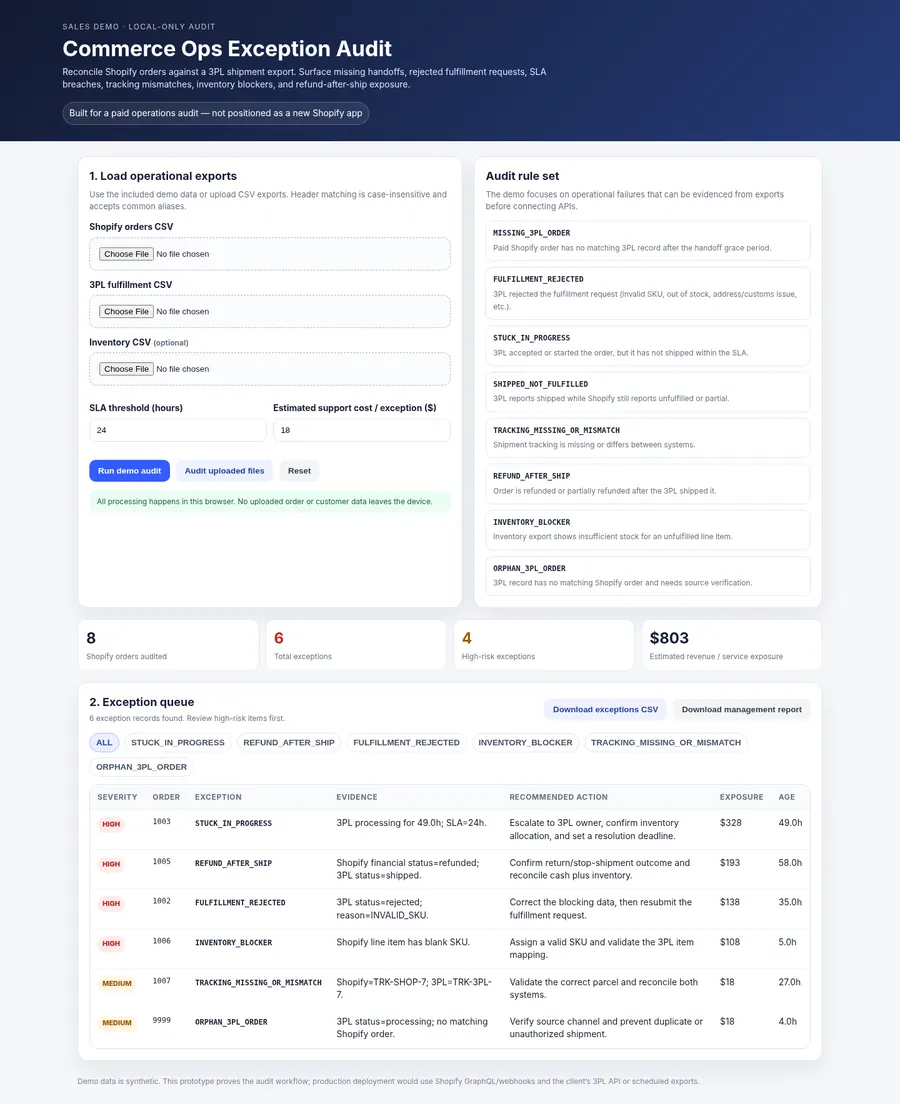
The audit produces an actionable exception queue with source evidence, severity, estimated exposure, likely root cause, and the next operational action.
Compare Shopify order states against the 3PL fulfillment and optional inventory export.
Rank issues by operational severity and estimated financial exposure.
Separate one-off data errors from repeatable workflow failures and define the highest-ROI automation.
Checks are applied only when the supplied data supports them.
Paid orders missing from the 3PL, rejected requests, and orphan records.
Orders stuck beyond SLA, shipped-but-unfulfilled states, missing or mismatched tracking.
Refund-after-shipment exposure, SKU mapping failures, and obvious inventory blockers.
The first engagement is deliberately small and read-only. It determines whether a larger integration or monitoring system is economically justified.
No. The audit is read-only. Any implementation or automated remediation requires a separate approved scope.
No. Names, addresses, phone numbers, and payment details are not required for the standard audit and should be removed where possible.
No. It is an operational reconciliation. Estimated exposure helps prioritize work and is not a guaranteed loss or recovery.
You can implement the recommendations internally or request a separate fixed-scope automation project.